₹5 Lakh Health Insurance in 2026: A Safety Net or a Safety Gap?
Is ₹5 lakh health insurance enough in 2026? See where a hospital bill goes, how co-pay and room rent limits cut your payout, and how a higher cover or super top-up closes the gap.
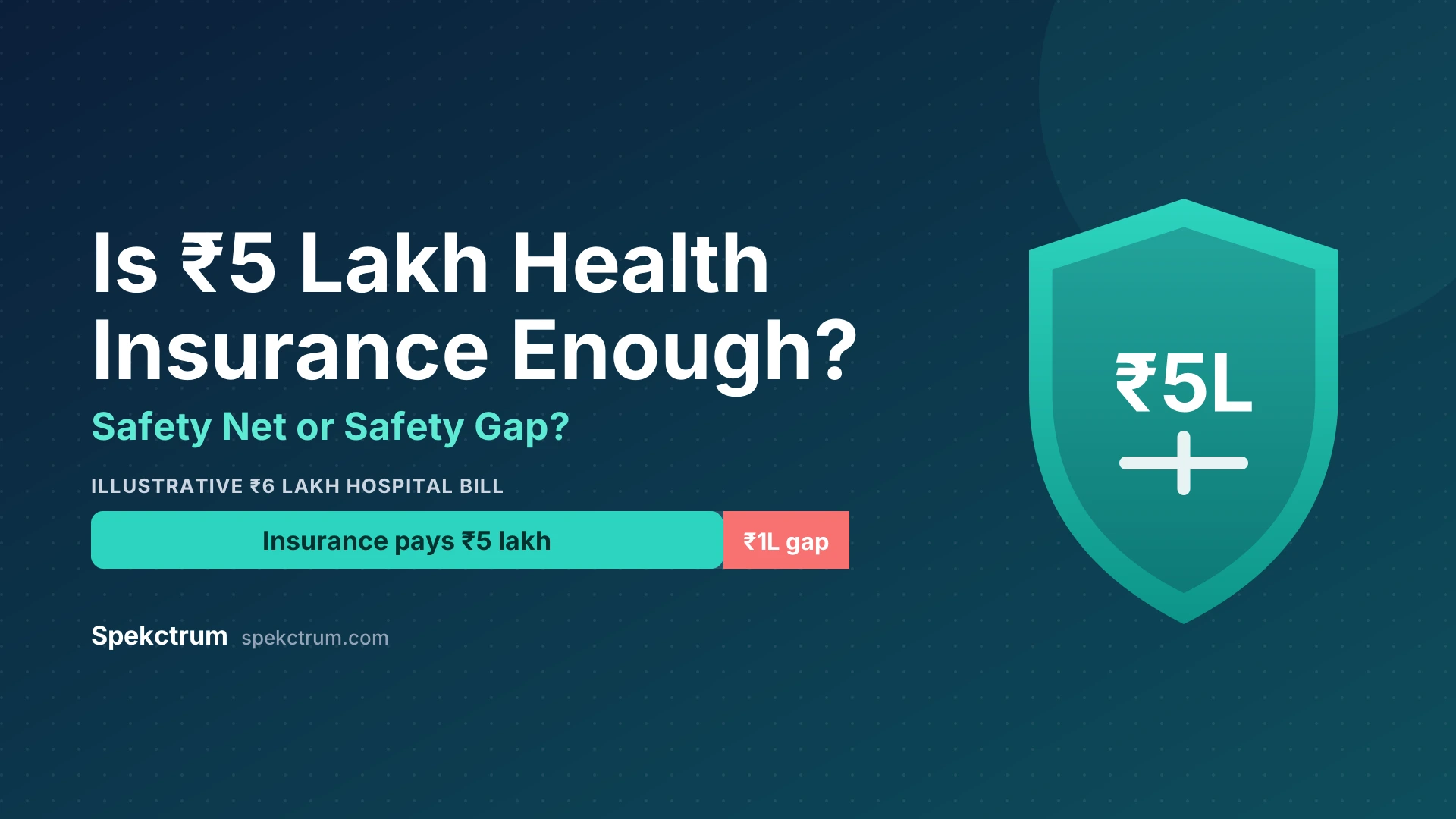
Most of us pick ₹5 lakh health cover because it sounds big. Then a hospital hands over a bill, and the number looks very different.
So here is the honest question: how much of that ₹5 lakh actually reaches the hospital when you need it? This guide walks through a real-looking bill, the quiet deductions that shrink a claim, and a simple way to decide what cover your own family needs.
The Short Answer
Single, young and healthy: ₹5 lakh is a fair starting point.
Couple or family with kids: it runs thin fast, and one claim can drain the pool.
Parents or seniors on the policy: it is rarely enough by itself.
Living in a metro: think of ₹5 lakh as the minimum, not the goal.
Where Does the Money Go in a Hospital Bill?
A hospital bill is not one lump sum. It is a long list of items, and your insurer treats each item differently. Here is an illustrative bill for a planned heart procedure at a private metro hospital. These figures are indicative, not a quote.
Bill Component | Illustrative Amount |
|---|---|
Room and ICU charges | ₹1,50,000 |
Surgeon, anaesthetist and OT fees | ₹1,80,000 |
Implants and surgical items | ₹1,20,000 |
Medicines and injections | ₹60,000 |
Tests and diagnostics | ₹40,000 |
Nursing, physiotherapy and other charges | ₹50,000 |
Total Bill | ₹6,00,000 |
Look at the total. It already crosses ₹5 lakh, and we have not added a single complication. Real costs change with the city, the hospital and the procedure, so ask a hospital near you for an estimate.
Four Ways Your ₹5 Lakh Shrinks Before You Use It
Even when a bill is below your sum insured, you may not get all of it back. These are the usual reasons.
1. Room Rent Capping
Some policies set a daily room rent limit. If you choose a costlier room, the insurer can reduce other room-linked charges in the same proportion.
Example: your limit is ₹5,000 a day, but you take a ₹10,000 room. Many policies would then pay only about half of charges like doctor visits and nursing. Always read how your own policy words this.
2. Co-Payment
With a 20% co-pay, you pay one-fifth of every approved claim. On a ₹4 lakh claim, that is ₹80,000 from your own pocket.
3. Sub-Limits and Disease Caps
Some plans cap specific treatments such as cataract, joint replacement or ICU stay. The cap applies even when plenty of your sum insured is left.
4. Non-Payable Items
Registration fees, some consumables, certain admin charges and a few devices are often excluded. Each looks small. Together they can run into tens of thousands.
A Bad Year on a ₹5 Lakh Family Floater
Take a family of four in Delhi-NCR sharing one ₹5 lakh floater. Here is how one rough year could look. The figures are illustrative.
Month | Event | Claim | Cover Left |
|---|---|---|---|
March | Parent has gallbladder surgery | ₹1,20,000 | ₹3,80,000 |
July | Child hospitalised with dengue | ₹60,000 | ₹3,20,000 |
November | Parent needs an emergency cardiac procedure | ₹4,50,000 | ₹0 (₹1,30,000 uncovered) |
None of these events is unusual on its own. But together they used up the whole pool and left a ₹1.3 lakh gap. That is the catch with floaters: everyone shares one limit, and it does not refill until renewal unless your plan has a restoration benefit.
Medical Costs Only Move One Way
Healthcare inflation in India has stayed in double digits, with industry commentary in 2026 putting it at roughly 12–14% a year. General retail inflation has been far lower. An actuarial analysis by Milliman also put the medical trend at 12% in 2024, with a projection of 13% for 2025.
Let us do the maths at 12% a year. A treatment that costs ₹5 lakh today could cost about ₹8.8 lakh in 5 years and about ₹15.5 lakh in 10 years. That is a projection for illustration, not a promise. But it shows why a cover bought today and never reviewed protects you less every year.
One industry study reported by Business Today found surgery costs rising by as much as 300% over a decade.
What the Rules Already Protect (IRDAI)
Cover size is only half the story. The regulator, IRDAI, has also set some basic protections that every health policyholder should know. Check the latest on the IRDAI health insurance page.
Waiting period for pre-existing diseases: a maximum of 3 years.
Moratorium period: after 5 years of continuous cover, a claim generally cannot be rejected for non-disclosure, except in fraud.
Cashless claims: insurers must decide a cashless request within 1 hour, and approve final settlement at discharge within 3 hours.
Portability: you can move to another insurer without losing the waiting period you have already served.
These rules help with claim speed and fairness. They do not raise your sum insured. If the bill is bigger than the cover, the gap is still yours.
A Simple 4-Step Way to Pick Your Cover
Price one serious procedure in your city. Ask a hospital for an estimate for a cardiac or cancer admission.
Add a 25–30% cushion. This covers non-payable items, a longer stay and complications.
Count everyone on the policy. A floater with parents needs more room than one for a young couple.
Check what you already have. Employer cover helps, but it usually ends when you change jobs.
This is a practical guideline, not a fixed rule. If you want a second opinion, the Spekctrum team can go through your options with you.
Three Ways to Close the Gap
Option | How It Works | Best For |
|---|---|---|
Increase the base sum insured | Move from ₹5 lakh to ₹10 lakh or ₹15 lakh at renewal | People who want one simple, higher policy |
Add a super top-up | A second policy that pays once your yearly claims cross a deductible | Families who want big cover at a lower extra cost |
Choose a plan with restoration | The sum insured refills after you use it up in a year | Families worried about repeat hospital stays |
How a Super Top-Up Really Works
Say you hold a ₹5 lakh base plan and a ₹20 lakh super top-up with a ₹5 lakh deductible.
Case A, one big claim of ₹12 lakh: the base plan pays ₹5 lakh and the super top-up pays ₹7 lakh.
Case B, two claims in one year of ₹3 lakh and ₹4 lakh: the claims are added together to ₹7 lakh, so the base pays ₹5 lakh and the super top-up pays the remaining ₹2 lakh.
That second case is why a super top-up beats a normal top-up. A normal top-up checks each claim on its own, so it may not pay when your claims are individually small.
You can compare cover options on our health insurance page.
Mistakes People Make
Choosing a plan only because the premium is low.
Skipping the fine print on room rent limits, co-pay and sub-limits.
Relying only on employer cover.
Never raising the sum insured after marriage, kids or a move to a metro.
Hiding a medical condition while buying, which can cause a claim to be rejected later.
Do Not Forget the Rest of Your Money Plan
Insurance covers the big shock. You still need ready cash for smaller bills and waiting periods. Build an emergency fund and review your long-term plan. Our wealth planning services can help, and this read on whether your money is working for you is a good next step.
If a gap is already in front of you and you need funds quickly, compare loan options carefully before you borrow. More guides like this are on the Spekctrum blog.
So, How Much Health Insurance Is Actually Enough?
There is no single number. The right cover depends on your age, family size, city, health history and the hospitals you would choose in an emergency.
If you are young, single and healthy, ₹5 lakh can be a sensible first step. If you are protecting a spouse, children or parents, or you live in a metro, aim higher. A base cover of ₹10–15 lakh, with a super top-up on top, leaves far more room for a serious illness or a year with several claims.
The best time to review your cover is before a hospital visit, not during one. Open your policy today, check the limits and deductions, and raise your cover when your family or city changes.
Frequently Asked Questions
It depends on who is covered and where you live. For one healthy adult it can work. For families and seniors in metro cities it often falls short.
Only if the bill is fully admissible. Co-pay, room rent limits, sub-limits and non-payable items can reduce the payout.
You pay the rest, unless you hold a super top-up or another policy that can respond.
It usually gives larger cover for a lower extra premium. A higher base plan is simpler, with no deductible to cross. The right choice depends on your budget.
Usually yes, at renewal, though the insurer may ask for health details. Check the waiting periods that apply to the added amount.
Many families start at ₹10–15 lakh as a base, and more when parents are covered. Use the 4-step method above to fine-tune it.
Explore Insurance Comparison & Advisory
Related Articles
All Articles Loans & Credit
How to Improve Your CIBIL Score Before Applying (2026)
Planning to apply for a loan? Here is a step-by-step plan to improve your CIBIL score before applying: fix report errors, keep card usage under 30%, avoid new enquiries and know how long it takes.